Blog

Corva Bella Farm Farrowing Kit

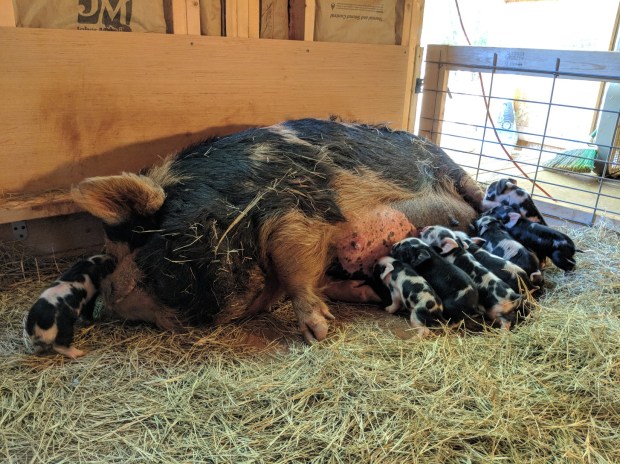
Your gilt or sow’s farrowing is always a miraculous time. It can also be a worrisome time if you’re new to pigs! We were once new to all of this too, but thankfully have had some great mentors and we are constantly learning and adding to our knowledge base.
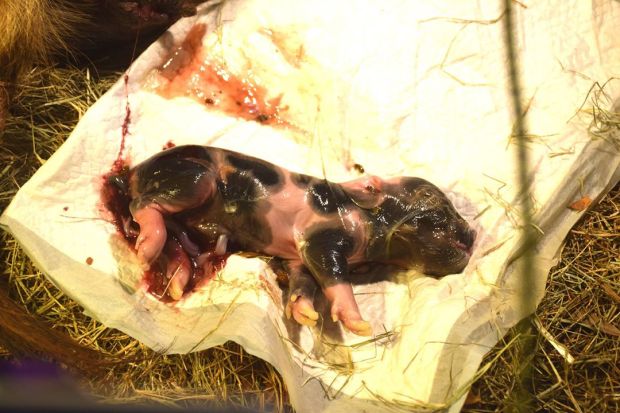
A piglet just seconds after birth. Note the deciduous hoove capsules (Eponychium), they are a rubbery texture that protect the sow from being injured by sharp hooves, during birth. They fall off within several minutes.
We keep the following items on hand just in case they’re needed. And our vet’s emergency number is always handy! We rarely need to use all of these things- in fact, most farrowings use the puppy pee pads, towels, bulb syringe, scissors and iodine only. As well as milk and electrolytes for the sow.
Prior to farrowing, our gilts & sows have been vaccinated with Rhinishield TX4 (5cc at 5 weeks before farrowing and a second booster of 5cc at 2 weeks prior), and wormed with Dectomax (intramuscular injection) OR Ivomec (subcutaneous injection). We carefully monitor their diet for the last few weeks, to ensure they are not overfed, which can result in large piglets that can potentially become stuck.
Our farrowing kit usually includes:

– puppy training pads to soak up birthing fluids

– white flour sack towels to dry off piglets

– a large towel/blanket or two

– clean bulb syringe

– nitrile gloves

– lubricant

– iodine/betadine

– vet wrap to wrap your sow’s tail if you wish to keep it clean (farrowing can get pretty messy!)

– Hoof trimmers (Use your sow’s down time to give them a little pedicure!)

– small scissors to cut umbilical cords

– a basket or tote to place piglets in if necessary

– beer (Can be used for calming a sow but it can go either way- not always the desired result)

– melatonin (Can be more effective than a beer to calm a sow, great trick learned from Bill Garlough/Ohio Valley Kunekunes)

– Oxytocin + (syringes, needles and alcohol prep pads)

– Calcium Gluconate injectable, if labor is progressing slowly

– Meloxicam or Banamine (Non-steroidal anti-inflammatory, given to sow if pain or swelling presents)

– electrolytes for sow ( Manna Pro Bounce Back)

– Karo syrup (rub on sow’s gums to keep energy up)

– Milk or dairy (given to sow for a few days before/after)

– Penicillin

– trash bags or pail to dispose of trash and/or afterbirth

– powdered colostrum

– goats milk (in case of milk issues)

– Piglets receive the following shots in their first week of life: Ferrodex 100 injectable iron (Day 3) & RespiSure 1 ONE for Swine (Day 7)

Last but not least, you should have a plan for humane euthanasia, in case you have any piglets born that are deformed, or with birth defects that will prevent them from having quality of life.

Sticky sesame riblets with spring onions

Something tasty is marinating!

Sticky ginger sesame ribs from our rare breed heritage pigs & riblets is what’s for dinner! We’re pairing them with a farm-grown romaine salad with a sesame dressing. Our ribs and riblets are smaller in size, so they are easy to thaw, marinate and prepare. How do you like your ribs?

Update- these ribs were a hit. For some reason, our customer demographic doesn’t purchase riblets, so we’re always looking for great recipes to prepare them with. I think if more people knew how delicious they were, they’d fly out of the freezer quite fast!

Get the recipe HERE.

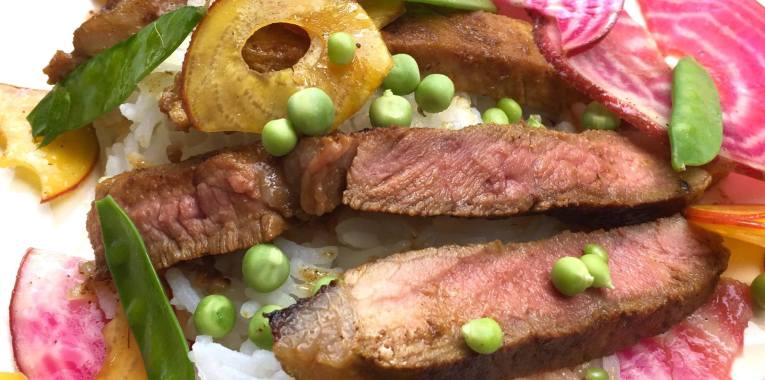
Pork steaks marinated in honey/yogurt/garlic/turmeric glaze, with beet & snow pea salad

Part of a modern farmer’s job is showing you delicious, seasonal things that you can cook with our products!

I love to cook and wish I could cook like this every day. Alas, my days are usually much more simple and speedy fare with the hectic schedule that we keep.

This is a fresh Meishan ham steak (fresh, not cured thin sliced pork steak) marinated overnight in a yogurt/honey/garlic/turmeric mixture and pan-seared about 3 minutes per side. If this were supermarket pork, you’d says “gosh, that’s raw!” But this is heritage pork, that starts off as red as beef… so the finished color is also pink, not white. This is just my preference for cooking, I consider this to be “medium”.

We fixed this over jasmine rice, with a chilled beet and snow pea salad over the top, using Chioggia and golden beets from the garden, green onion, and snow peas. It was delicious!

If you’d like snow peas or beets to pick up at the Saturday market, send me a PM. I’ll be custom-harvesting beets for customers who’d like to purchase, because my beet harvest is limited.

Get the recipe HERE.

$8 fancy coffee drink or $8 sausage? Why is one seen as too expensive?

I posted this on Instagram the other day, while we were set up at the farmers market. My post was a reaction to a common situation that small farmer’s face- being made to feel that our product is too expensive, but seeing those same people who hold that notion- spending money freely on items that they perceive to have value. In this example, that item was expensive coffee drinks. I got some hassle online over this example, because some felt my example wasn’t fair because I didn’t show the cost and labor breakdown for what it took to produce that cup of coffee, such as beans being grown and roasted, or a cup being manufactured. That’s not what this example is about. In it’s simplest terms, this example is about how we live in a society that will readily drop $8 on a unicorn frappuccino or other fancy beverage, but tell a small farmer that their pasture raised eggs, pork, beef or chicken- are too expensive.

My post was met with resounding agreement by other farmers. If you’re a consumer who feels that pastured meats are too expensive, I understand that financially you may not be able to afford the meats that small farmers such as my son and I raise. That’s alright- you can still be an advocate and supporter for small farms, and support your local farmers market. I strongly believe that we should be eating higher quality meat, even if it means eating less meat! If you’re a consumer that is financially able to spend $8 on sausage, but sees no value in it, then please consider the hard work, passion and time that goes into the production of pastured proteins, and how humane farming is so important in comparison to the alternative- government subsidized factory farming, where animals are farmed en masse indoors, and never see outdoor or pastured conditions. Please don’t make small farmers doing it the right way- feel badly about what they need to charge for their product.

Please note that the sausage in this post reflects the price of premium/gourmet linked sausage for MY area. I know farmers raising heritage crosses to 6 months old, and charging this for linked sausages. We raise rare Kunekune and Meishan pigs to 12-18 months old, which are smaller pigs by nature- and we are still charging $12. Price of sausage in your area may be different- please don’t get stuck on the price of the product and overlook the message of the post, the fact that as a society we have a disparity in our perception of what food items have more value than others.


The original post:

This cappuccino was made in minutes and cost over $5. This pack of garlic bratwurst costs $8.76 and took over a year for the pig to grow out. Most breeds reach market weight by 6-7 months. Our rare breed Kunekune and Meishan pigs take 12-18 months- and they are still a smaller pig with a lower yield than what most pastured pig farmers work with.

The pig was fed by us over 300 times, and watered twice a day or more by us, in all weather both freezing, and torrid hot.

We checked on the health of the pig daily, and then drove two hours each direction to deliver the pig to our processor, and two hours back.

Then we made that trip again to pick up the meat and pay our processing bill, which for two pigs that hung at 160 pounds each, was $581 (normal costs for our geographic region for dispatch, vacuum sealing, sausage blending, sausage linking, curing, and specialty ingredient costs).

Then we unpacked the meat and store it in freezers that cost $500 each, and pay the electricity to run them.

Every time we go to the farmers market, we leave the farm with a truck packed with coolers of meat, set up our tent and table display, and then sit for hours meeting and greeting customers and selling our pork.

This is why sausage is $12 per lb. This is what humanely raised, rare breed pork actually costs.That is a premium price, but it reflects what we need to receive in order to be able to continue farming, feeding our animals and having some money to put back into our farm.

I can’t put a time estimate on the amount of labor put towards maintaining fencing and structures, driving to purchase feed and hay, growing produce and other food for the pigs, driving to pick up loads of apples or pumpkins. We bring piglets into the world, sleeping in the barn for the first few nights of their lives, to make sure they all survive those first critical days. We see the pigs every single day, multiple times a day until it is their time to bless us with their sacrifice, and provide good, clean, properly raised pork for our community.

Most people think meat is cheap and easy to produce. It isn’t. It is back breaking and heart wrenching work, especially to do it properly and humanely, while being good stewards to the land.

I know we are not alone in our plight to educate the public about the true cost of our product. Society has trained us that meat is cheap, and fresh vegetables are expensive. Think about that for minute. We live in a society where people don’t think twice about spending $8 on a unicorn frappuccino, but may consider the same dollar amount spent on locally and humanely raised pork, chicken, beef, eggs or produce… to be too much money. Real food raised by small farmers.

© 2018 Cristiana Calderan Bell, Corva Bella Farm

Kunekune pork- the other red meat. Old fashioned pork, with rich flavor, creamy & firm fat quality and taste beyond compare.

How our Pork is Different!

Market season has begun, and with it we continue our work ardently educating our customers about our breed conservation efforts and how our pork is different. This is our greatest challenge, as people are so used to seeing pork as a cheap, white, readily available meat. We are going against the grain, and it’s not easy to change mindsets.

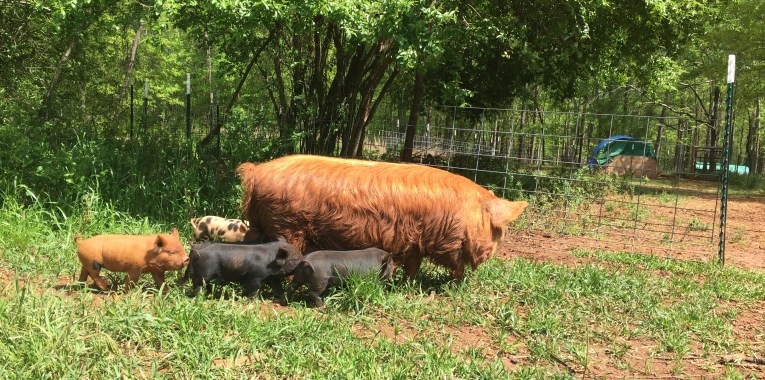
 In the South, it’s not uncommon for even small farmers to raise pigs in confinement, on concrete- or in a small pen. Some folks are always surprised that our pigs are free ranging, or that they are smaller in size, or that we don’t sell “whole hog sausage” for $3/lb. We live in a society where meat is seen as a cheap commodity, while vegetables are seen as a luxury. Most customers will readily spend $4-5 per pound for fresh broccoli, but balk at spending $12/lb for a beautiful & marbled nutrient-rich pork chop that took 12-18 months and a whole lot of hard work, love and dedication to produce.
 .
The reason for this is that we are trained to expect meat to be cheap. And factory farms pump out millions of animals per year to meet that cheap, government subsidized demand. What most consumers don’t understand is that the vast majority of large-scale agriculture, from corn & wheat to pork & beef out of confinement buildings and feed lots- is government subsidized. You do pay more for that meat, you just don’t realize where your tax dollars are going. Factory farms unfortunately are necessary to meet demand, but as consumers we always have the choice to take our buying power where we wish, and keeping dollars local and invested in small farms is the smart choice for sustainability and our local economy!
 Our pork is a premium product, that you won’t find at any grocery store and you may not even be able to find a product like it at most farmer’s markets. It is unusual for a small farm to be centered solely around rare breed conservation and working with smaller pigs with long growout times and smaller meat yields- but here we are, doing just that.
 .
The topic of confinement pork- what almost all “supermarket pork” is, always comes up at the farmers market. Factory farmed pork consists of thousands of pigs being raised indoors, in an enclosed space. There is no comparison between this and what pastured farmers do!
 .
In our case, we also factor in the unique meat and fat quality of our rare breed pigs. Both the Kunekune and Meishan pigs produce intricately marbled meat- the equivalent of being the “Waygu beef of the pork world”.
.
How are our pigs different?
.
  • Unlike supermarket pork, our pigs are bred for taste rather than leanness. They are an old fashioned style pig, known as a “lard breed”.
  • Our pork is different by sight alone- the deep red color is both inherent to the breed’s genetics, as well as the slow, outdoor rearing.
  • Pigs reared outdoors, and raised slowly (12-18 months) results in excellent marbling and intramuscular fat, creating incredibly tender pork.
  • Slow growth means a tastier product.
  • Our are happy pigs, and happy pigs taste better. We’d never consider raising pigs in a tiny pen, indoors, or on concrete. Ours are reared outside, free ranging on pasture and in the forest. Piglets stay with their mothers until 6-10 weeks of age depending on breed, litter size, and sow condition.
  • Kunekune and Meishan pigs are bred by a few select breeders who prioritize the breed’s purity, conformation and traceability via pedigreed registration.
  • In buying rare breed pork, you are helping to create demand for rare breeds in need of conservation, which in turn will encourage breeders to continue working with these amazing animals to meet demand for both breeding stock and meat stock!
  • In short, every bite of our pork helps to conserve the breeds we work with. It makes it possible for us to continue our work, manage the intricacies of our breeding program, and do our best work possible.
Thank you for putting rare breed heritage pork on your fork!


Put [rare breed heritage pork] on your fork! How our pork differs from “supermarket” pork

Market season has begun, and with it we continue our work ardently educating our customers about our breed conservation efforts and how our pork is different. This is our greatest challenge, as people are so used to seeing pork as a cheap, white, readily available meat. We are going against the grain, and it’s not easy to change mindsets.

This slideshow requires JavaScript.

 In the South, it’s not uncommon for even small farmers to raise pigs in confinement, on concrete- or in a small pen. Some folks are always surprised that our pigs are free ranging, or that they are smaller in size, or that we don’t sell “whole hog sausage” for $3/lb. We live in a society where meat is seen as a cheap commodity, while vegetables are seen as a luxury. Most customers will readily spend $4-5 per pound for fresh broccoli, but balk at spending $12/lb for a beautiful & marbled nutrient-rich pork chop that took 12-18 months and a whole lot of hard work, love and dedication to produce.
 .
The reason for this is that we are trained to expect meat to be cheap. And factory farms pump out millions of animals per year to meet that cheap, government subsidized demand. What most consumers don’t understand is that the vast majority of large-scale agriculture, from corn & wheat to pork & beef out of confinement buildings and feed lots- is government subsidized. You do pay more for that meat, you just don’t realize where your tax dollars are going. Factory farms unfortunately are necessary to meet demand, but as consumers we always have the choice to take our buying power where we wish, and keeping dollars local and invested in small farms is the smart choice for sustainability and our local economy!

This slideshow requires JavaScript.

 Our pork is a premium product, that you won’t find at any grocery store and you may not even be able to find a product like it at most farmer’s markets. It is unusual for a small farm to be centered solely around rare breed conservation and working with smaller pigs with long growout times and smaller meat yields- but here we are, doing just that.
 .
The topic of confinement pork- what almost all “supermarket pork” is, always comes up at the farmers market. Factory farmed pork consists of thousands of pigs being raised indoors, in an enclosed space. There is no comparison between this and what pastured farmers do!
 .
In our case, we also factor in the unique meat and fat quality of our rare breed pigs. Both the Kunekune and Meishan pigs produce intricately marbled meat- the equivalent of being the “Waygu beef of the pork world”.
.
How are our pigs different?
.
  • Unlike supermarket pork, our pigs are bred for taste rather than leanness. They are an old fashioned style pig, known as a “lard breed”.
  • Our pork is different by sight alone- the deep red color is both inherent to the breed’s genetics, as well as the slow, outdoor rearing.
  • Pigs reared outdoors, and raised slowly (12-18 months) results in excellent marbling and intramuscular fat, creating incredibly tender pork.
  • Slow growth means a tastier product.
  • Our are happy pigs, and happy pigs taste better. We’d never consider raising pigs in a tiny pen, indoors, or on concrete. Ours are reared outside, free ranging on pasture and in the forest. Piglets stay with their mothers until 6-10 weeks of age depending on breed, litter size, and sow condition.
  • Kunekune and Meishan pigs are bred by a few select breeders who prioritize the breed’s purity, conformation and traceability via pedigreed registration.
  • In buying rare breed pork, you are helping to create demand for rare breeds in need of conservation, which in turn will encourage breeders to continue working with these amazing animals to meet demand for both breeding stock and meat stock!
  • In short, every bite of our pork helps to conserve the breeds we work with. It makes it possible for us to continue our work, manage the intricacies of our breeding program, and do our best work possible.
Thank you for putting rare breed heritage pork on your fork!

Purchase our pork through the Clemson Area Food Exchange, serving Oconee/Pickens/Anderson counties!

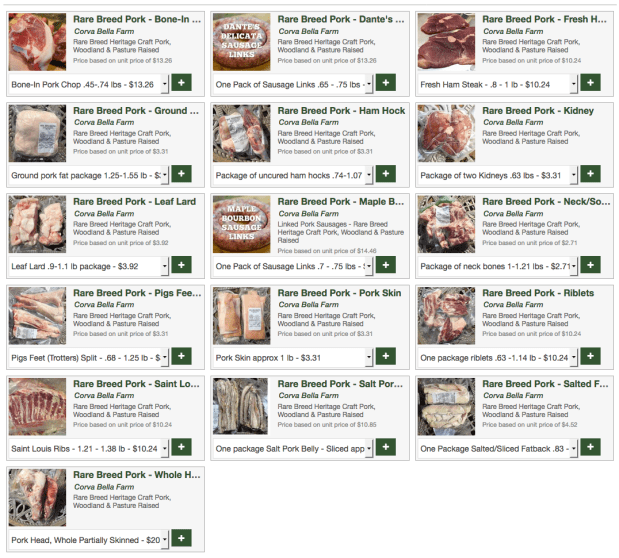
You can purchase our rare breed pork on the Clemson Area Food Exchange (CAFE)! No need to drive out to the farm, this is an online farmers market that runs every weekend from 9 PM EST Friday to Noon Monday!
CLICK HERE TO SHOP OUR PORK!


Various pickup points on Tuesdays:

Clemson: Tuesdays from 3:30-6 pm at The Arts Center.

Seneca: Tuesdays from 5-6:30 pm at Oconee Medical Center.

Easley – Hospital: Tuesdays from 4:30-6 pm at Baptist Easley Hospital in their cafeteria

Easley – Farmacy: Tuesdays from 4:30-6 pm

Pickens: Tuesdays from 5:30-7:30 pm at Appalachian Ale House located at 205 E Main Street

Anderson: Tuesdays from 5-6 pm at The Kitchen Emporium located at 311 N Main Street

For $10 you can also have a delivery to your home, if you are within ten miles of Clemson or Seneca!


Let’s talk about Coefficient of Inbreeding- COI

Let’s talk about COI in relation to breeding… COI = coefficient of inbreeding. In other words, the degree of relatedness that two pigs have. COI is just a number. It’s just a tool- one of many- that you might use when assessing a pig to add to your herd, or two pigs you want to breed together.

There’s a lot of confusion about COI and a lot of misconception that a low COI = a better quality pig. This is not a hard & fast rule and is especially confusing to those that are new to breeding and purchasing their first pigs. It can be overwhelming, and in a lot of cases, new buyers are probably passing up higher quality pigs left and right in favor of purchasing only those with low COI. The truth is that with COI, you have to look at the big picture. Not only all of your breeding pairs, but potentially the pairings of your pair’s offspring as well. Don’t exclude a pig based on COI alone.

Chickie, above- is an exceptional Jenny sow with wonderful conformation and type. She is the product of a line bred dam (with 35% COI) completely outcrossed to an unrelated sire with 0% COI. Her Grandparents were half siblings and cousins all at the same time. Chickie has a low 5.9% COI.


I’d rather have a pig with amazing conformation and a higher COI, than a pig with low COI that should have been a cull. Why? Because I can outcross that higher COI pig to a pig that is unrelated, and have low COI offspring. I can also cross a high COI pig to another high COI pig and end up with low COI offspring! But the low COI pig that is poor quality? It would take a few generations of breeding to improve that pig’s offspring, if it was even worth doing so in the first place. In that case, you’d have to consider other factors- such as, “is this pig a more rare bloodline that needs improvement and population?” or “does this pig have potential major faults that disqualify it from breeding?


Morgana, Chickie’s half sister, is an exceptional piglet who is line bred, and her COI is 26%. She will be outcrossed to a totally unrelated boar in the next generation, our Tutanekai, Lorenzo. He has an almost nonexistent COI of .4%- but it’s not just his COI that is appealing for Morgana, it is his conformation and color, as well. Here is her Morgana’s pedigree, so that you can see the common ancestors on dam/sire sides.


Why would we add a piglet to our herd with higher COI? Because we observed the consistent results that Morgan’s current owner had achieved through two litters of piglets, and we were very impressed by the offspring. These were piglets with exceptional growth rates, consistently strong conformation and type, and a body type well-suited to our pork production goals. Morgana’s genetics will be a valuable tool for us to work with.


At this time, the best pigs in our herd have higher COI’s, or were born out of one or both parents with higher COI’s (outcrossing). The truth is that a breed is both conserved AND maintained through a combination of line breeding and outcrossing. The key word here is MAINTAINED. When you breed two pigs together, you have chosen to breed those pigs for a variety of reasons. Hopefully, one of the reasons was because you chose traits in each one that you wanted to see expressed in future generations. When you line breed, you’re increasing the likelihood that certain traits will be expressed more consistently. On the flip side, you’re also increasing the likelihood that undesirable traits can appear, so you must be prepared to cull if need be (thankfully that is where a pork production program goes hand in hand with line breeding).

Again- breeding two higher COI pigs together doesn’t mean that the resulting offspring will have an even higher COI. In many cases, the COI will be lower, as in the case of Calliope (13.4% COI) and Giuseppe (14% COI). Their offspring would be a reasonable 9.9% COI, lower than both parents. Why? Because while both parents have higher COI, they are also less related when paired. It’s genetics.


COI is not the end-all, be-all indicator of quality in a breeding pig. Consider it, but don’t let yourself be ruled by it. Look at the pedigrees, and look at the pigs that appear with greater frequency in a line-bred pedigree (especially the closer generations). Most importantly, look at the pig itself! Look at it’s conformation, and that of it’s dam and sire.

“Tapeka Trait” Kunekune piglets are coming to South Carolina!


We’re incredibly excited to announce that “Tapeka Trait” piglets will be arriving on the farm in the near future.

These beautiful babies are coming to us all the way from Washington State, bred by Pamela Farris at ROCK STAR Vittle Piggies – RSVP

We are adding a boar and a gilt that display the high white/black/ginger color blocking known as the “Tapeka Trait”. You can find full information about the Tapeka & Ivanleigh Belly Band traits on the AKPR Facebook page.

These piglets will potentially produce belting, color blocking and more high percentage white with accents of black and ginger, when paired with certain pigs in our herd.

Not only that, but the Tapeka bloodline has some of the fastest growth rates/size and largest litter sizes of all Kunekune bloodlines. Growth rates are very important to our farm goals.

So without further ado, please meet our upcoming Tapeka Trait additions:

The gorgeous high white gilt (with ginger/black spotted head), “RSVP Siouxsie Sioux” (Wilsons Gina/Tuahuru x BH Tutaki/Tapeka) and the high white/black boar, “RSVP Freddie Mercury” (Tapeka/Boris x Mahia Love or Andrew)

Stay tuned for more pictures, and their eventual arrival!

Come on out and try our new MAPLE BOURBON sausage!

We’ve worked hard on perfecting this recipe, and after several test batches, it is perfect and ready to roll out! Our newest sausage variety- MAPLE BOURBON- will be available for purchase at this weekend’s markets, or for farm gate pickup.

This decadent premium linked sausage contains generous amounts of real maple syrup and Wild Turkey 101 bourbon. We hope to eventually work with a local Upstate distillery and use their bourbon, but for now, we opted for familiarity! Blended with our rare breed heritage Kunekune pork, herbs and spices.

We’ll be cooking up samples at both the Foothills Heritage Market on Saturday morning (Westminster SC) and at the Pumpkintown Farmers Market in Pumpkintown SC near Table Rock, from 1:30 to 5 PM in the afternoon.

We’ll also have our other sausage varieties:

Dante’s Delicata- sweet italian sausage with asiago cheese & spinach

Giuseppe’s Garlic & Sweet Onion

Mild traditional sage breakfast links

And of course, a full range of pork cuts!

See you there!!!

#thinkoconee #oconeecounty #pickenscounty#takemetopickens #kunekunepork #heritagepork#putporkonyourfork #adifferentkindofpigadifferentkindofpork