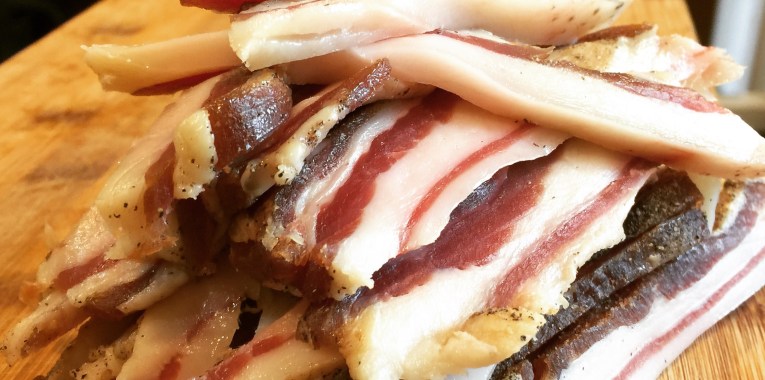
Kunekune pork- the other red meat. Old fashioned pork, with rich flavor, creamy & firm fat quality and taste beyond compare.

Simple Traditional Kunekune Maple Bacon! (wet cure)

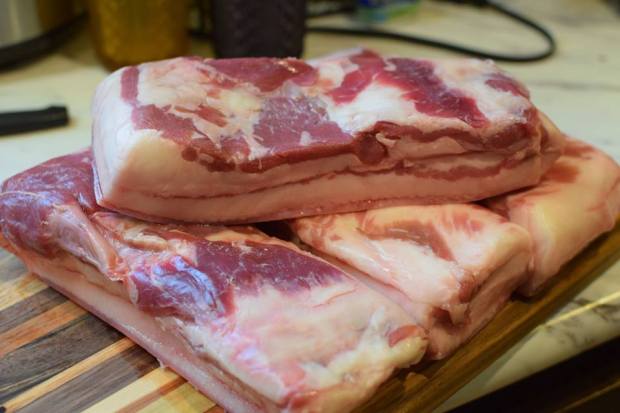
Using these gorgeous pieces of Kunekune pork belly, we’re sharing the process for you to easily make your own bacon at home. It’s a lot easier than you think, and only takes about 30 minutes. This is a wet cure method. You can also dry cure with just salt, sugar and spices- and leave out the prague powder, but that’s a much longer process. This is simple and excellent to start with.


Here’s what you need: Kosher Salt, Dark Brown Sugar, Dark Maple Syrup, Black ground pepper, Prague powder #1 (optional, but provides more traditional bacon taste), and water.

After thawing the pork bellies for several days, I removed the skin carefully and with a very sharp knife.

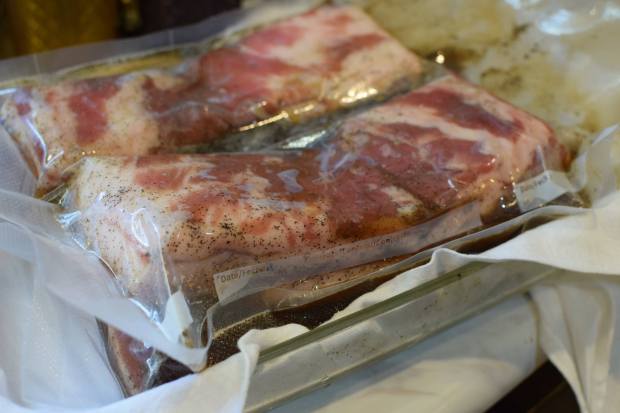
I used vacuum seal bags, but you could just use gallon zip lock bags.

For 8 lbs pork belly I used:

9 tsp kosher salt
9 tsp black pepper
6 tbsp dark brown sugar
1 tsp prague powder #1
1 cup dark maple syrup
1.5 cups water

Mix thoroughly and add to your pork belly in the bag. Distribute evenly and either vacuum seal on the gentle/moist setting, or try to get as much air out of your gallon zip loc bag as possible.

We’ll cure this for 3-4 days in the refrigerator, and then move on to the smoking process. Every day I’ll redistribute the cure within the bag to make sure it all cures evenly.

If you don’t have access to a smoker, you can cook your bacon low & slow in your oven with the addition of some liquid smoke for flavor. While this is curing, I’ll decide what type of wood I’d like to smoke it with. Pecan or Cherrywood sounds nice, but so does Applewood and Hickory! We’ll be smoking this in our cabinet smoker.

Kunekune pork- the other red meat. Old fashioned pork, with rich flavor, creamy & firm fat quality and taste beyond compare.

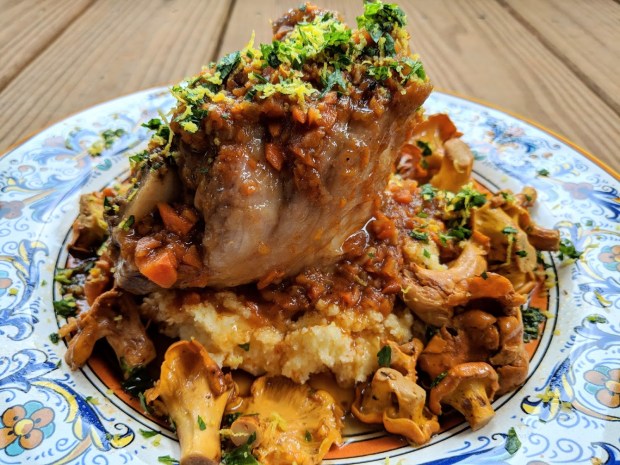
Kunekune Pork Osso Buco with Chanterelles, Polenta and Gremolata 


An easy & flavorful interpretation of the Northern Italian classic, featuring pork shank instead of veal.

One large pork shank, skin removed.

Salt & pepper shank, dredge in flour and brown on all sides in olive oil, set to side.

Add 2 minced cloves of garlic, one carrot, one stick celery and one onion, diced- to olive oil, add salt, cook until transparent.

Add one cup dry white wine and 1 tablespoon of tomato paste, stir well and reduce liquid by half over low heat.

Add pork shank back in, add one cup chicken broth, cover and cook on low until meat is falling off the bone- this time ranges based on size of shank.

Sautee chanterelles in olive oil.

Prepare polenta.

Plate and serve!

Gremolata is a finely diced parsley, garlic & lemon zest added as a final step.

Buon appetito!

Praise the Lard!


48384466_2241616386095629_8560694106756481024_o

Lard. The word itself often evokes a visceral reaction. Known as “saindoux” in French, “strutto” in Italian, “schmalz” in German, “manteca” in Spanish, and “laridum” in Latin, the word’s etymological source… lard is often used as both a negative connotation and an insult.

Did you ever wonder why most people today see lard as something disgusting and unpalatable? One hundred years ago, lard was found in every home, not only as a primary cooking & baking fat, but also in personal care products and candles. It was also used industrially as a machining lubricant.

Lard fell out of favor in the early 1900’s and is slowly but surely making a comeback. So how did lard fall from grace? It was essentially, a carefully planned corporate coup.

First, there was Upton Sinclair, whose novel “The Jungle” painted an unseemly portrait of meat packing in general, and the fact that the fictional work portrayed men falling into boiling lard rendering vats. Sinclair wrote The Jungle to expose the appalling working conditions in the meat-packing industry. His description of the working conditions and meat itself shocked the public and led to new federal food safety laws.

Next? Crisco. Proctor & Gamble created Crisco in 1910, the hydrogenated vegetable oil that looks like lard. It’s sole purpose was to replace lard in every American kitchen and utilize the cottonseed oil production chain formerly used to create candles. With the invention of the light bulb, candle production waned. Excess oil needed a use- and that use was hydrogenated vegetable oil. Proctor & Gamble led the one of the most expansive food advertising campaigns ever, to boost Crisco while demonizing lard. They gave it away for free, produced cookbooks and ran advertisements that claimed it was more digestible and healthier than lard. Lard wasn’t completely out of the picture, but it’s use was no longer dominant.

Then, in the 1950’s scientists joined in nay-saying lard, with medical claims that saturated fats, such as those found in lard, caused heart disease. Turns out… they were ALL wrong. And it’s actually Crisco and highly processed vegetable oils and hydrogenation that is what’s unhealthy.

Fast forward to the present, where we see lard becoming more accepted and even welcomed- by local food, farm to table movements, pastured livestock farming, and nose-to-tail utilization of humanely raised animals.

To make things more complicated, all pigs are not created equal. There are “lard breeds” and there are “bacon breeds”. Lard breeds are your old fashioned type of pigs, which fatten easily and produced copious amounts of fine-grained, buttery, firm and delicious lard. Lard breeds are compact and thick, with deep bodies and short legs. They include swine such as Kunekune, Meishan, American Guinea Hog, Ossabaw, Mangalitsa, and Potbelly. Bacon breeds are your commercial meat producers. They are lean, long and muscular and include breeds such as Tamworth, Duroc, Hereford, Yorkshire and Modern Berkshire. Some breeds have a little bit of both! These include English Berkshire, Gloucester Old Spots, Large Black, Red Wattle, and Mulefoot, to name a few. Most pastured pork producers utilize cross-breeds of various bacon-type breeds. Very few use lard breeds because they are smaller, and can take 3-4 times longer to grow out to a smaller weight, at that. Combined with the higher amount of fat on their carcass, they are frequently shunned by pastured pork farmers. We go against the grain by working exclusively with lard breeds. Why? Taste. There is nothing quite like the taste of slow-grown, intricately marbled meat from a lard pig. And the fat quality is unrivaled. All of the lard pig breeds other than potbelly pigs (typically seen as pets) are seen as rare and in some cases, critically or globally endangered. This makes a farmer’s work with them both valuable and important- a form of breed conservation through utilization. Breed the best, eat the rest!

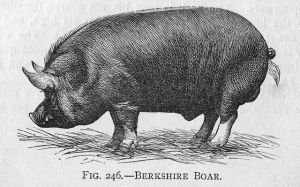
Here’s an example between an old fashioned (English) Berkshire boar, and a modernized American one- selectively bred for fast growth and meat production. The English type is more of a lard type.
But back to lard… the lard you find in the modern grocery store is hydrogenated and shelf stable. Don’t buy this- it isn’t even remotely the same type of product you’d get from small farmers raising swine on pasture and in forest land. Pigs raised outdoor with natural forage, grasses, and a potentially omnivorous diet (pigs can and do eat snakes, amphibians, insects, and more!) produce fats with a much healthier lipid profile, as well as more vitamin D. Better than butter? We sure think so! Lard is lower in saturated fat than other animal fats like butter and tallow, and higher in heart-healthy monounsaturated fat—the type that gives olive oil its popularity. Lard has a high smoke point, making it a choice cooking and frying oil. And it’s one of the best fats to use in baking, especially biscuits or pie crusts!

We offer lard in several ways. At this time, we don’t offer plain, rendered lard. We do offer leaf lard (the internal fat), and back fat (the layer of fat found on the back and partway down the sides). Lard is very easy to render at home, store in the refrigerator or freezer, and utilize as a cooking fat. Southern cuisine is well-known for incorporating “salted fatback”, which is a salt-cured form of the fatback, usually offered sliced. We carry this as well. But our most unique and delicious product utilizing the creamy & pristine fat from our rare breed pigs is our Whipped Lardo, also known as “Crema di Lardo”.

The first time I experienced this was while traveling in central Italy. Umbria, to be exact- during wild boar season. Connor and I ate many dishes with “cinghiale”, and at one point experienced whipped lardo made with leaf fat combined with herbs & spices, vinegar and garlic. It was heaven!

Whipped Lardo can be used wherever you use cooking oils, fats or butter, and it incorporates both your cooking fat and your seasoning! We currently offer it in five different varieties: Rosemary & Garlic, Red Pepper & Fennel, WIldflower Honey & Sea Salt, Italian Herb, and Herbes de Provence. We are one of only a few farms in the entire United States that is producing Whipped Lardo for resale, and at this time- the only farm in South Carolina! Our rare breed lard pigs are exceptionally well-suited to producing the type of premium fat that is utilized in the lardo. In Italy, historically lardy breeds, often acorn-finished- are utilized as well.

We also utilize our lard in personal care products, such as handcrafted lard soaps, salves and balms. Our aim is to fully utilize the whole hog, and the fat is where it’s at! A portion of the hog that many modern-day producers simply end up discarding, for us- is an extremely important product that we choose to utilize and elevate!

Some more interesting reading about lard:

https://www.thedailymeal.com/healthy-eating/5-reasons-why-lard-new-coconut-oil

http://www.asiaone.com/health/pork-fat-ranked-among-top-10-most-nutritious-foods-report

https://www.prevention.com/food-nutrition/a20488068/should-you-be-eating-lard/


Sticky sesame riblets with spring onions

Something tasty is marinating!

Sticky ginger sesame ribs from our rare breed heritage pigs & riblets is what’s for dinner! We’re pairing them with a farm-grown romaine salad with a sesame dressing. Our ribs and riblets are smaller in size, so they are easy to thaw, marinate and prepare. How do you like your ribs?

Update- these ribs were a hit. For some reason, our customer demographic doesn’t purchase riblets, so we’re always looking for great recipes to prepare them with. I think if more people knew how delicious they were, they’d fly out of the freezer quite fast!

Get the recipe HERE.

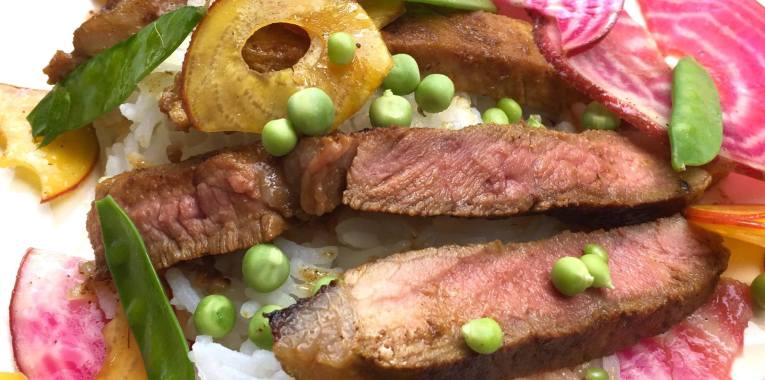
Pork steaks marinated in honey/yogurt/garlic/turmeric glaze, with beet & snow pea salad

Part of a modern farmer’s job is showing you delicious, seasonal things that you can cook with our products!

I love to cook and wish I could cook like this every day. Alas, my days are usually much more simple and speedy fare with the hectic schedule that we keep.

This is a fresh Meishan ham steak (fresh, not cured thin sliced pork steak) marinated overnight in a yogurt/honey/garlic/turmeric mixture and pan-seared about 3 minutes per side. If this were supermarket pork, you’d says “gosh, that’s raw!” But this is heritage pork, that starts off as red as beef… so the finished color is also pink, not white. This is just my preference for cooking, I consider this to be “medium”.

We fixed this over jasmine rice, with a chilled beet and snow pea salad over the top, using Chioggia and golden beets from the garden, green onion, and snow peas. It was delicious!

If you’d like snow peas or beets to pick up at the Saturday market, send me a PM. I’ll be custom-harvesting beets for customers who’d like to purchase, because my beet harvest is limited.

Get the recipe HERE.

$8 fancy coffee drink or $8 sausage? Why is one seen as too expensive?

I posted this on Instagram the other day, while we were set up at the farmers market. My post was a reaction to a common situation that small farmer’s face- being made to feel that our product is too expensive, but seeing those same people who hold that notion- spending money freely on items that they perceive to have value. In this example, that item was expensive coffee drinks. I got some hassle online over this example, because some felt my example wasn’t fair because I didn’t show the cost and labor breakdown for what it took to produce that cup of coffee, such as beans being grown and roasted, or a cup being manufactured. That’s not what this example is about. In it’s simplest terms, this example is about how we live in a society that will readily drop $8 on a unicorn frappuccino or other fancy beverage, but tell a small farmer that their pasture raised eggs, pork, beef or chicken- are too expensive.

My post was met with resounding agreement by other farmers. If you’re a consumer who feels that pastured meats are too expensive, I understand that financially you may not be able to afford the meats that small farmers such as my son and I raise. That’s alright- you can still be an advocate and supporter for small farms, and support your local farmers market. I strongly believe that we should be eating higher quality meat, even if it means eating less meat! If you’re a consumer that is financially able to spend $8 on sausage, but sees no value in it, then please consider the hard work, passion and time that goes into the production of pastured proteins, and how humane farming is so important in comparison to the alternative- government subsidized factory farming, where animals are farmed en masse indoors, and never see outdoor or pastured conditions. Please don’t make small farmers doing it the right way- feel badly about what they need to charge for their product.

Please note that the sausage in this post reflects the price of premium/gourmet linked sausage for MY area. I know farmers raising heritage crosses to 6 months old, and charging this for linked sausages. We raise rare Kunekune and Meishan pigs to 12-18 months old, which are smaller pigs by nature- and we are still charging $12. Price of sausage in your area may be different- please don’t get stuck on the price of the product and overlook the message of the post, the fact that as a society we have a disparity in our perception of what food items have more value than others.


The original post:

This cappuccino was made in minutes and cost over $5. This pack of garlic bratwurst costs $8.76 and took over a year for the pig to grow out. Most breeds reach market weight by 6-7 months. Our rare breed Kunekune and Meishan pigs take 12-18 months- and they are still a smaller pig with a lower yield than what most pastured pig farmers work with.

The pig was fed by us over 300 times, and watered twice a day or more by us, in all weather both freezing, and torrid hot.

We checked on the health of the pig daily, and then drove two hours each direction to deliver the pig to our processor, and two hours back.

Then we made that trip again to pick up the meat and pay our processing bill, which for two pigs that hung at 160 pounds each, was $581 (normal costs for our geographic region for dispatch, vacuum sealing, sausage blending, sausage linking, curing, and specialty ingredient costs).

Then we unpacked the meat and store it in freezers that cost $500 each, and pay the electricity to run them.

Every time we go to the farmers market, we leave the farm with a truck packed with coolers of meat, set up our tent and table display, and then sit for hours meeting and greeting customers and selling our pork.

This is why sausage is $12 per lb. This is what humanely raised, rare breed pork actually costs.That is a premium price, but it reflects what we need to receive in order to be able to continue farming, feeding our animals and having some money to put back into our farm.

I can’t put a time estimate on the amount of labor put towards maintaining fencing and structures, driving to purchase feed and hay, growing produce and other food for the pigs, driving to pick up loads of apples or pumpkins. We bring piglets into the world, sleeping in the barn for the first few nights of their lives, to make sure they all survive those first critical days. We see the pigs every single day, multiple times a day until it is their time to bless us with their sacrifice, and provide good, clean, properly raised pork for our community.

Most people think meat is cheap and easy to produce. It isn’t. It is back breaking and heart wrenching work, especially to do it properly and humanely, while being good stewards to the land.

I know we are not alone in our plight to educate the public about the true cost of our product. Society has trained us that meat is cheap, and fresh vegetables are expensive. Think about that for minute. We live in a society where people don’t think twice about spending $8 on a unicorn frappuccino, but may consider the same dollar amount spent on locally and humanely raised pork, chicken, beef, eggs or produce… to be too much money. Real food raised by small farmers.

© 2018 Cristiana Calderan Bell, Corva Bella Farm

Come on out and try our new MAPLE BOURBON sausage!

We’ve worked hard on perfecting this recipe, and after several test batches, it is perfect and ready to roll out! Our newest sausage variety- MAPLE BOURBON- will be available for purchase at this weekend’s markets, or for farm gate pickup.

This decadent premium linked sausage contains generous amounts of real maple syrup and Wild Turkey 101 bourbon. We hope to eventually work with a local Upstate distillery and use their bourbon, but for now, we opted for familiarity! Blended with our rare breed heritage Kunekune pork, herbs and spices.

We’ll be cooking up samples at both the Foothills Heritage Market on Saturday morning (Westminster SC) and at the Pumpkintown Farmers Market in Pumpkintown SC near Table Rock, from 1:30 to 5 PM in the afternoon.

We’ll also have our other sausage varieties:

Dante’s Delicata- sweet italian sausage with asiago cheese & spinach

Giuseppe’s Garlic & Sweet Onion

Mild traditional sage breakfast links

And of course, a full range of pork cuts!

See you there!!!

#thinkoconee #oconeecounty #pickenscounty#takemetopickens #kunekunepork #heritagepork#putporkonyourfork #adifferentkindofpigadifferentkindofpork

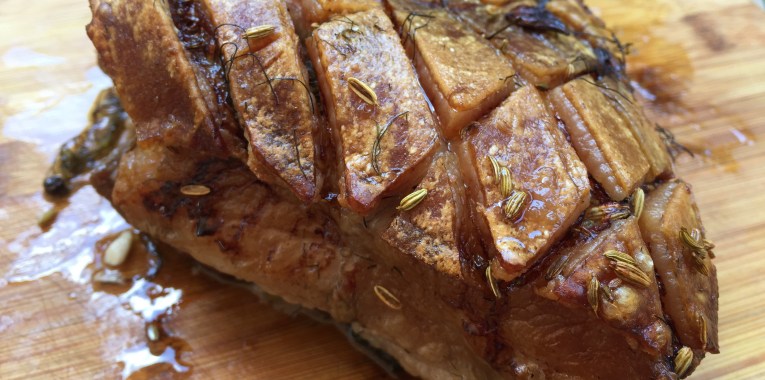
Delicious: succulent and crispy roasted Kunekune pork belly

Last week,  15 year old Connor, who is a HUGE fan of Gordon Ramsay, found this recipe and requested that we cook it up ASAP. I sent him off to the meat freezer to find the perfect piece of pork belly for this adventure. Yesterday afternoon, we enjoyed this scrumptious dish, made even more perfect accompanied by summer squash and bread left over from last Saturday’s market.


Yes, we DO have pork belly available for purchase!


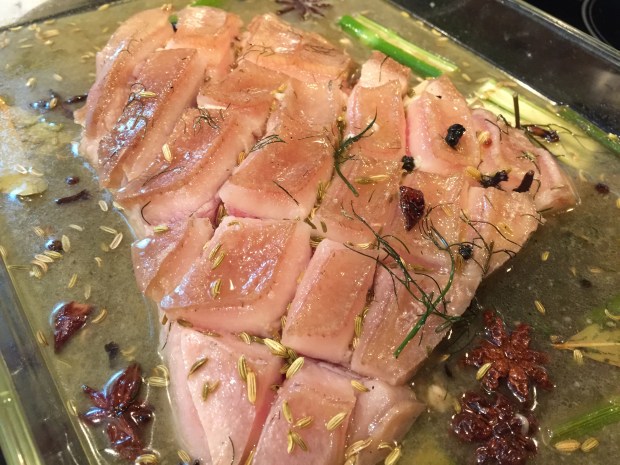
Our fennel is on the way out, so we did our best to get some of that flavor in with a small bulb and some stems. And we didn’t have cardamom, so we substituted with some black peppercorns and clove buds instead. Overall the recipe turned out wonderfully… but our skin on top was a bit too hard to chew in places, so next time we’ll play around with the cooking times and temps.


In the video Gordon mentions 180 degrees. Is this celsius or fahrenheit? I don’t know. We set our oven to bake at 356 degrees and baked our smaller piece of pork belly for 90 minutes instead of the 2.5 hours he suggests. Next time we will try 180 F, instead.


Scored, seared and ready to go into the oven, resting in a pool of our farm chicken stock and a melange of spices.


All done!

Our First Proprietary Linked Sausage Now Available… “Dante’s Delicata”

Check out our newest premium sausage, available at the weekly Pumpkintown Market Farmers Market, or farm gate pickup!

This is “Dante’s Delicata“, a sweet Italian sausage with Asiago cheese and organic spinach, pork provided by our rare breed heritage Kunekune pigs.

It’s named after my Grandfather, Dante Calderan (shown pictured as a young boy in Corva, Italy, with my Great Grandmother Augusta)

A range of package sizes are available, with larger sizes being a sausage wheel.

USDA processed and packed by Foster’s Meats, Inc.