


Lard. The word itself often evokes a visceral reaction. Known as “saindoux” in French, “strutto” in Italian, “schmalz” in German, “manteca” in Spanish, and “laridum” in Latin, the word’s etymological source… lard is often used as both a negative connotation and an insult.
Did you ever wonder why most people today see lard as something disgusting and unpalatable? One hundred years ago, lard was found in every home, not only as a primary cooking & baking fat, but also in personal care products and candles. It was also used industrially as a machining lubricant.


Lard fell out of favor in the early 1900’s and is slowly but surely making a comeback. So how did lard fall from grace? It was essentially, a carefully planned corporate coup.
First, there was Upton Sinclair, whose novel “The Jungle” painted an unseemly portrait of meat packing in general, and the fact that the fictional work portrayed men falling into boiling lard rendering vats. Sinclair wrote The Jungle to expose the appalling working conditions in the meat-packing industry. His description of the working conditions and meat itself shocked the public and led to new federal food safety laws.
Next? Crisco. Proctor & Gamble created Crisco in 1910, the hydrogenated vegetable oil that looks like lard. It’s sole purpose was to replace lard in every American kitchen and utilize the cottonseed oil production chain formerly used to create candles. With the invention of the light bulb, candle production waned. Excess oil needed a use- and that use was hydrogenated vegetable oil. Proctor & Gamble led the one of the most expansive food advertising campaigns ever, to boost Crisco while demonizing lard. They gave it away for free, produced cookbooks and ran advertisements that claimed it was more digestible and healthier than lard. Lard wasn’t completely out of the picture, but it’s use was no longer dominant.

Then, in the 1950’s scientists joined in nay-saying lard, with medical claims that saturated fats, such as those found in lard, caused heart disease. Turns out… they were ALL wrong. And it’s actually Crisco and highly processed vegetable oils and hydrogenation that is what’s unhealthy.
Fast forward to the present, where we see lard becoming more accepted and even welcomed- by local food, farm to table movements, pastured livestock farming, and nose-to-tail utilization of humanely raised animals.
To make things more complicated, all pigs are not created equal. There are “lard breeds” and there are “bacon breeds”. Lard breeds are your old fashioned type of pigs, which fatten easily and produced copious amounts of fine-grained, buttery, firm and delicious lard. Lard breeds are compact and thick, with deep bodies and short legs. They include swine such as Kunekune, Meishan, American Guinea Hog, Ossabaw, Mangalitsa, and Potbelly. Bacon breeds are your commercial meat producers. They are lean, long and muscular and include breeds such as Tamworth, Duroc, Hereford, Yorkshire and Modern Berkshire. Some breeds have a little bit of both! These include English Berkshire, Gloucester Old Spots, Large Black, Red Wattle, and Mulefoot, to name a few. Most pastured pork producers utilize cross-breeds of various bacon-type breeds. Very few use lard breeds because they are smaller, and can take 3-4 times longer to grow out to a smaller weight, at that. Combined with the higher amount of fat on their carcass, they are frequently shunned by pastured pork farmers. We go against the grain by working exclusively with lard breeds. Why? Taste. There is nothing quite like the taste of slow-grown, intricately marbled meat from a lard pig. And the fat quality is unrivaled. All of the lard pig breeds other than potbelly pigs (typically seen as pets) are seen as rare and in some cases, critically or globally endangered. This makes a farmer’s work with them both valuable and important- a form of breed conservation through utilization. Breed the best, eat the rest!
Here’s an example between an old fashioned (English) Berkshire boar, and a modernized American one- selectively bred for fast growth and meat production. The English type is more of a lard type. 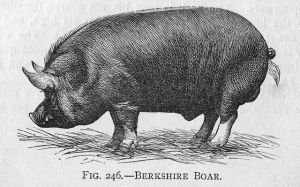

But back to lard… the lard you find in the modern grocery store is hydrogenated and shelf stable. Don’t buy this- it isn’t even remotely the same type of product you’d get from small farmers raising swine on pasture and in forest land. Pigs raised outdoor with natural forage, grasses, and a potentially omnivorous diet (pigs can and do eat snakes, amphibians, insects, and more!) produce fats with a much healthier lipid profile, as well as more vitamin D. Better than butter? We sure think so! Lard is lower in saturated fat than other animal fats like butter and tallow, and higher in heart-healthy monounsaturated fat—the type that gives olive oil its popularity. Lard has a high smoke point, making it a choice cooking and frying oil. And it’s one of the best fats to use in baking, especially biscuits or pie crusts!
We offer lard in several ways. At this time, we don’t offer plain, rendered lard. We do offer leaf lard (the internal fat), and back fat (the layer of fat found on the back and partway down the sides). Lard is very easy to render at home, store in the refrigerator or freezer, and utilize as a cooking fat. Southern cuisine is well-known for incorporating “salted fatback”, which is a salt-cured form of the fatback, usually offered sliced. We carry this as well. But our most unique and delicious product utilizing the creamy & pristine fat from our rare breed pigs is our Whipped Lardo, also known as “Crema di Lardo”.
The first time I experienced this was while traveling in central Italy. Umbria, to be exact- during wild boar season. Connor and I ate many dishes with “cinghiale”, and at one point experienced whipped lardo made with leaf fat combined with herbs & spices, vinegar and garlic. It was heaven!


Whipped Lardo can be used wherever you use cooking oils, fats or butter, and it incorporates both your cooking fat and your seasoning! We currently offer it in five different varieties: Rosemary & Garlic, Red Pepper & Fennel, WIldflower Honey & Sea Salt, Italian Herb, and Herbes de Provence. We are one of only a few farms in the entire United States that is producing Whipped Lardo for resale, and at this time- the only farm in South Carolina! Our rare breed lard pigs are exceptionally well-suited to producing the type of premium fat that is utilized in the lardo. In Italy, historically lardy breeds, often acorn-finished- are utilized as well.
We also utilize our lard in personal care products, such as handcrafted lard soaps, salves and balms. Our aim is to fully utilize the whole hog, and the fat is where it’s at! A portion of the hog that many modern-day producers simply end up discarding, for us- is an extremely important product that we choose to utilize and elevate!


Some more interesting reading about lard:
https://www.thedailymeal.com/healthy-eating/5-reasons-why-lard-new-coconut-oil
http://www.asiaone.com/health/pork-fat-ranked-among-top-10-most-nutritious-foods-report
https://www.prevention.com/food-nutrition/a20488068/should-you-be-eating-lard/
 Corva Bella Farm